“A picture is worth a thousand words.” – Fred R. Barnard (Ad Exec)
A marketing image tells you how the product looks but not how it will look on your pet. That distinction matters when a buyer is choosing a harness for a Labrador, a bed for a tiny terrier, or a grooming tool for a long-haired cat.
In pet e-commerce, the right picture can answer questions that product specifications cannot: Does it fit? Is it the right scale? How will it look in use? The problem is that creating those images traditionally means animals, handlers, locations, and hours on set. A Higgsfield AI Animal Generator offers a practical way to create that missing visual context without replacing the real merch photography underneath it.
Why Does the On-Pet Shot Matter More Than the Packshot?
Pet shoppers shop emotionally and then check practically, in that order.
The emotional part is recognition. A pet parent wants to see the product on an animal that looks something like theirs, because that is how they picture it in their own home. The practical part is fit and scale, which no white-background image can answer.
Listings with a clear photo of the product in use trump the ones with tens of lifestyle collages. The merch is being bought for someone who cannot be consulted, which makes visual reassurance do more work than usual.
The trouble is that every one of those lifestyle images requires an animal, and animals are the least collaborative models in commercial photography.
Why Are Live Animal Shoots So Difficult?
Anyone who has organized one already knows this, and anyone who has not tends to underestimate it comprehensively.
- Unlike humans, animals don’t hold poses. A dog can be encouraged, bribed, or persuaded. But all goes down the drain when it looks away as soon as you capture the photo.
- Handlers are required. For safety and for the animal’s welfare, which means more people on set and a longer day.
- Trained talent is scarce. The supply of properly trained animal models is thin, and booking one for a small brand’s roster refresh is rarely straightforward.
- Outdoor shoots add weather and permits. Park and beach settings look wonderful and carry real scheduling risk. Storing production equipment is a task in itself.
- Sessions run long and produce little. A shoot that yields a handful of usable frames after several hours is normal rather than unlucky.
- And the variant maths breaks everything. A leash brand may have to shoot all the product colors on several breeds. The shoot list becomes unworkable for a small team. An AI Animal Generator turns that list from a scheduling problem into a description.
What Does an AI Animal Generator Do?
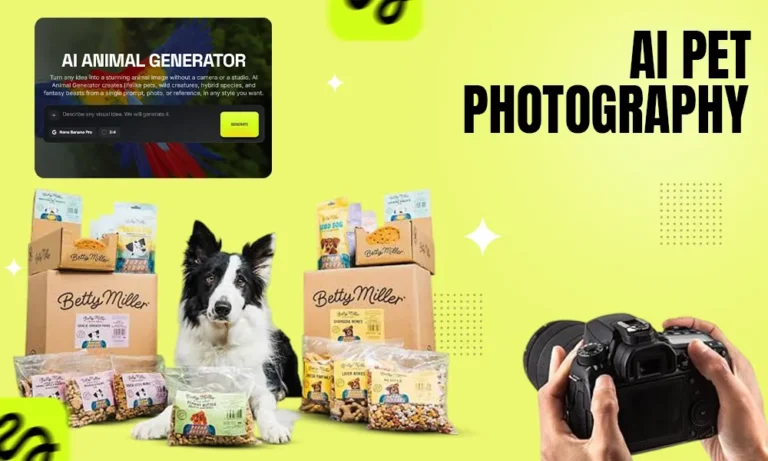
It produces images of animals from a written description:
- Breed
- Size
- Coat type
- Setting
- Pose
- Lighting condition
For a pet brand, the useful application is context. The room, the park, the walk, the mealtime scene, the animal in the frame giving the merch scale and warmth. Describe a long-haired cat on a windowsill in morning light, or a medium-sized short-coated dog lying on a rug, and you receive that image rather than searching a stock library for the nearest approximation.
One platform, Higgsfield, offers this as it is an AI creative suite rather than a single-purpose tool, generating the animal imagery, adjusting it, and preparing format variants all happen in one place instead of across separate services, which matters when a catalog refresh means dozens of images rather than one.
An AI Animal Generator is not a replacement for the product photograph. It is the surrounding context that has never been able to supply cheaply.
The Breed Problem, and Why It Costs Sales
This is the point most brands overlook, and it is where a text-to-animal AI earns its place most clearly.
Pet parents project. A buyer with a beagle looks at a harness modeled on a German shepherd and cannot tell whether it will work. A buyer with a long-haired cat looks at a grooming product demonstrated on a short-haired one and quietly moves on.
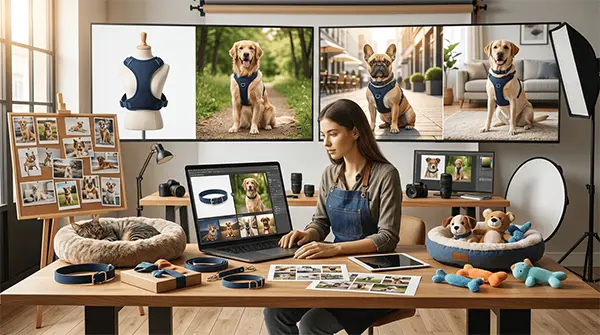
Showing the same merch across several breed types, small, medium, and large dogs, short and long coats, and different colorings answers the fit question for a far wider slice of the audience.
A real shoot requires booking five different breeds, which seems impractical. Generating the same scene across several breed appearances is a matter of changing a few words in a description. Higgsfield keeps those saved descriptions together, so the same breed set can be reapplied to the next product rather than rebuilt each time.
That single capability is worth more to a pet catalog than almost anything else an AI Animal Generator does.
Where Generated Imagery Belongs in a Listing?
Being meticulous about placement matters because different images in a listing are doing different jobs.
Generated imagery works well for:
- Lifestyle and context scenes showing the environment with merch use
- Scale reference where an animal in frame conveys size
- Breed variation across a set, answering fit questions for different buyers
- Different seasons and settings
- Social and advertising creative supporting a launch
- Email and banner imagery where the product is not the sole subject
Real photography remains the right answer for:
- The main listing image, showing the actual product
- Material and texture close-ups where the buyer is assessing quality
- Anything showing a mechanism, closure, or adjustment
- Packaging shots where labelling must be legible and accurate
The rule underneath that split is simple. Generated content handles the world around; Photography handles the product.
SURPRISING STAT
As per Etsy, 90% of shoppers consider product photography a critical purchasing factor.
The Line Not to Cross
Pet e-commerce punishes inaccuracy harder than most categories, because the buyer discovers the problem when the item arrives, and their animal cannot use it.
Market by these three rules:
- Never alter the product. Generated scenes can change the room, the light, and the animal. They must not change a clasp, a bed’s fill depth, a label, a strap width, or a toy’s texture. Those are the facts the buyer is purchasing.
- Never invent specifications. Dimensions, padding, materials, and performance claims come from the specs, not from an image that happens to look plausible.
- Check against the real item before publishing. A polished scene proves nothing on its own. The check takes moments and prevents returns.
Used within those limits, an AI Animal Generator is straightforwardly useful and entirely defensible, and Higgsfield or any comparable tool sits comfortably inside them. Outside of them, no production method makes a misleading listing acceptable.
Where Real Photography and Retouching Still Do the Work
AI can’t do it all.
Fur is still the hardest thing in this category, and it is where skilled manual work continues to outperform automation. Edge work on long coats, wispy fur against a busy background, the boundary where a harness meets a dense double coat — these are precision tasks, and brands photographing real animals in real settings still need proper masking and retouching to get them right.
Anyone marketing into a breed-specific or premium market feels this most. Buyers in those segments know what their animal’s coat looks like, and they notice when an image does not.
Reflective products need real handling too. Metal bowls, glossy food packaging and shiny toys create reflections that require deliberate lighting and careful correction rather than generation.
Color accuracy is paramount. A collar sold as slate grey needs to arrive as slate grey.
The strongest pet catalogs combine all of it: real photography, professional retouching and masking for the product images, and an AI Animal Generator supplying the lifestyle context that would otherwise require an animal, a handler, and a day nobody has.
A Practical Workflow
Photograph the merch properly first. Clean, sharp, accurately colored, from every angle a customer will want. Everything downstream depends on this.
Get the retouching done on those images. Masking, background removal, color correction, shadows. This is the foundation of the listing.
Decide the contexts you need. Home, park, mealtime, walk. Two or three per product is usually enough.
Decide the breed set. Small, medium, and large, with a mix of coat types. Think clearly about it and keep it noted.
Generate the context imagery. An AI Animal Generator handles this quickly once the descriptions are settled, and Higgsfield keeps the set together for reuse on the next product.
Assemble the gallery in the right order. Main merch image first, lifestyle and context in the following slots.
Review every image against the physical item. Then publish.
Marketplace Requirements Worth Checking
Different platforms have different rules, and getting these wrong is a listing rejection rather than a design preference.
Amazon requires a pure white background on the main image with the product fully visible and permits lifestyle imagery in the subsequent slots that pet brands routinely underuse. Other sites have their own rules.
The practical consequence is that generated context imagery belongs in the secondary slots, which is exactly where it does the most good anyway. Higgsfield producing the same scene at several aspect ratios saves preparing each marketplace’s format separately.
Tips for Better Results
Describe the coat, not just the breed. Length, texture, and coloring give an AI Animal Generator far more to work with than the breed term alone.
Keep the setting simple. A busy scene competes with the merch.
Name the light. Soft window light, overcast outdoor, warm evening. It sets the mood more than any other single element.
Generate several and choose. Variation between attempts is normal, and comparison takes moments.
Keep the look consistent. This is what makes a gallery feel like a brand. A text-to-animal AI applied with the same saved description across products delivers that automatically.
Check it small. Most buyers see these images as thumbnails first, and Higgsfield exports at listing dimensions, so the check is accurate.
Final Thoughts
The on-pet photo has always been the image that sells pet products and the image that brands skip, because live animal shoots are expensive, unpredictable, and difficult to scale across a catalog.
An AI Animal Generator makes that shot achievable, and Higgsfield and comparable tools make producing a full breed set about as much work as producing one image. What it does not do is photograph the product, mask the fur on a real shoot, or correct the color of a collar so it matches what arrives in the box.
First, get the product photo perfectly right. Then use a text-to-animal AI for the world around it. Higgsfield handles that half; skilled editors handle the other with top photo editing software. That combination is what a strong pet listing actually looks like.
Frequently Asked Questions
Q1. Can generated imagery be used on Amazon listings?
Ans: In the secondary slots, yes. Images from an AI Animal Generator are subject to Amazon’s regulations on accuracy and its requirement for a plain white main image showing the actual product. The main image should always be a real photograph.
Q2. Does it replace hiring a pet photographer?
Ans: Not for the merch images or for anything where the animal itself is the subject being sold. A text-to-animal AI replaces the lifestyle and context shots that would otherwise require booking an animal, which is where the cost and scheduling difficulty actually sit.
Q3. How realistic is the fur?
Ans: AI has a hard time getting it right, but the situation is improving. For premium and breed-specific markets, real photography with skilled retouching remains the stronger choice.
Q4. Can the same product be shown on several breeds?
Ans:Yes, and this is the strongest reason to use an AI Animal Generator in a pet catalog. Answering the fit question for more buyers is the most direct route to fewer abandoned carts.
Q5. What must never be generated?
Ans: Anything that changes the merch itself or any specification a buyer relies on. Whatever an AI Animal Generator produces belongs in the scene, not in the product.