The AI assistant is used to quickly create tools to automate processes. It covers renaming, resizing, tagging, and prepping assets.
The insightful to save time and reduce reputation is priority. If your catalogues scale extensively with SKUs, you have to figure out the tools create issues. Like errors in the process, bottleneck issues, and memory loss.
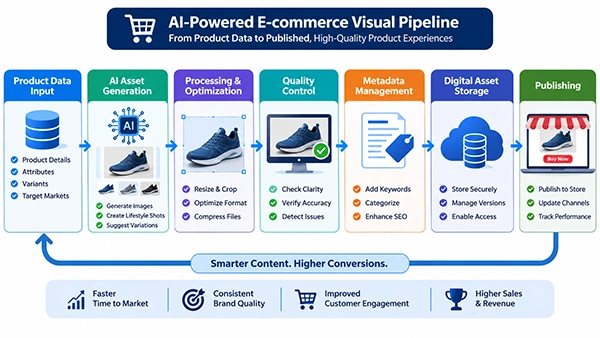
This is periodically due to the prototype code generated for small batches and not used continuously. To scale, you have to require the strongest pipeline for the assets. including intake, processing, quality assurance, metadata, storage, serving, and monitoring.
Implementing an event-based process, structured metadata with automated checks alongwith exception in checking with provenance tracking improves the workflows smoothly.
Initially, you are not only creating the images faster but also making sure your assets are correct, traceable, and ready to be published.
Technical Bottlenecks in Rapidly Built Visual Processing Utilities
Most prompt-generated software applications are created to exhibit quick functionality. Instead of handling scalable and high-throughput file operations. When non-technical creators prompt AI assistants to create an image processing tool, the resulting code typically depends on synchronous client-side execution or simple serverless functions.
These implementations execute tasks sequentially, which means loading raw images into browser memory, performing canvas manipulation, and sending heavy payloads over single HTTP connections. While this approach works well for small test batches, processing high-resolution raw photography or multi-layered PSDs. It instantly depletes available memory limits, leading to browser tab impacts and declined connection requests.
When your custom image processing tools start handling high-resolution TIFF or PSD exports across multi-region distribution networks. The structural debt, like API rate limits exceeded, memory leaks in canvas rendering, and unencrypted file storage, becomes obvious.
Engineering teams often depend on specialized vibe coding cleanup services to review the auto-generated codebases. They convert weak synchronous scripts with robust asynchronous queues and increase security features without rebuilding the user interface from scratch. This refactoring makes sure that high-volume catalog ingestion remains stable during large volume spikes without triggering server timeouts.
Another persistent challenge in auto-generated pictorial writings is improper handling of color management profiles and file metadata. AI-generated code frequently strips embedded ColorSync or ICC profiles during image re-encoding. This leads to slight changes in hue, saturation, and contrast when your images display on different client devices.
Additionally, if they are not optimised properly the file serialization can purge EXIF metadata possessing copyright parameters. Also with photographer attribution, and camera exposure settings. Conserving this metadata requires replacing original canvas conversion methods with specialised image processing libraries such as Libvips or Sharp.
Essential Architectural Benchmarks for High-Volume Asset Pipelines
Upgrading a visual processing tool from a delicate prototype into a scalable enterprise asset pipeline. You need to alter how computational workloads are distributed. while dealing with high-volume image workflows must separate user-facing interface movements from background file transformations to maintain responsive control dashboards.
To achieve operational stability, engineering teams execute core architectural features designed specifically for bulk media handling:
- Asynchronous Task Queuing: Implementing message brokers such as Redis or RabbitMQ allows the application to ingest bulk upload requests instantly. This queues file-processing requests across distributed worker nodes instead of processing images, blocking the main application thread.
- Streamed Cloud File Storage: By uploading directly to your object storage via presigned S3 URLs. It prevents media assets from passing through application servers. It instantly reduces bandwidth overhead and server memory consumption.
- Isolated Image Processing Microservices: By separating image transformation processing into individual worker services running optimized C-based native bindings ensures high-speed resizing, background removal, and conversion to modern WebP and AVIF formats.
The table below illustrates the key operational differences between unoptimized AI-generated visual tools and enterprise-grade media pipelines:
| Operational Dimension | AI-Generated Prototype | Enterprise Asset Pipeline |
|---|---|---|
| Execution Pattern | Synchronous, single-threaded processing | Asynchronous, dispersed queue workers |
| Memory Management | Canvas memory with High risk of crashing | Stream-based file chunking and buffer release |
| Color Fidelity | Basic canvas re-encoding (losing profile) | Strict ICC profile protection via Sharp or Libvips |
| API Rate Handling | Unhandled HTTP 429 errors during spikes | Exponential backoff and choked token bucketting |
| Data Security | Hardcoded API keys and Processing on client | IAM role and KMS payload encryption |
Quality Control and Metadata Integrity Protocols
Exceeding structural refactoring, automated visual asset pipelines require rigid assurance gates. This ensures that processed images meet strict commercial presentation standards before reaching consumer channels.
In e-commerce environments, you should align the irregular image, adjusted aspect ratios, or incorrect background cropping. It can directly impact conversion rates and brand perception. Automated testing protocols must validate resulting files against specified visual parameters prior to publishing assets to headless commerce endpoints such as Shopify GraphQL API or Magento REST services.
Establishing programmatic quality assurance affects deploying automated visual regression checks alongside traditional unit tests. Modern pipelines run post-processing visual diffing tools to compare generated variants against expected images. This will detect unexpected alpha-channel relics, unwanted edge anti-aliasing, or boundary cropping errors. Automated scripts ensure that color space conversions correctly default to standard sRGB profiles for web rendering while maintaining original archival assets in wide-gamut configurations.
Security compliance represents another critical area usually overlooked during rapid tool creation. Prototyped tools often store cloud credentials, API tokens, and access keys in client-side scripts or unencrypted environment files. Hardening the application requires executing zero-trust authentication protocols and securing environment variables within secret management systems like AWS Secrets Manager or HashiCorp Vault. Implementing role-based access control (RBAC) across all organizational endpoints.
Sustaining Operational Efficiency Through Structured Technical Evolution
The ability to rapidly create prototype internal visual automation tools using AI platforms has reduced the barrier to technical innovation for creative and functional teams.
You also need to ensure the initial software concepts are turned into trustworthy, commercial-grade asset pipelines. This demands deliberate architectural refinement. By identifying potential vulnerabilities early, converting asynchronous task panels. And also enforcing strict metadata and security standard where organizations can successfully bridge the gap between rapid prototyping and enterprise functional dependability.
Investing in good code architecture and systematic testing ensures your automated visual workflows scale seamlessly as catalog volume grows. Eventually, this will help protect your brand, reduce manual production overhead, and enable creative teams to supply high-quality visual experiences across all digital customer touchpoints.
Frequently Asked Questions
What metadata should be added to AI-generated product assets?
You should add SKUs, Product ID, Locale, Channel, Dimensions, Source, Generation Method, Version, Approved, and Date-Time.
Why is quality control for images important at an enterprise level?
Automated validation ensures that there are no problems with the visuals before they are broadcast.
What is C2PA provenance for AI-generated images?
The C2PA Content Credentials deliver a digitally signed record of the roots and narrative of an asset.
What metrics should be tracked within the AI asset pipeline?
It can be traced by throughput, Queue Time, Process Time, Failures, Rework, Manual Checks, Cost per Approved Asset, and publish success.