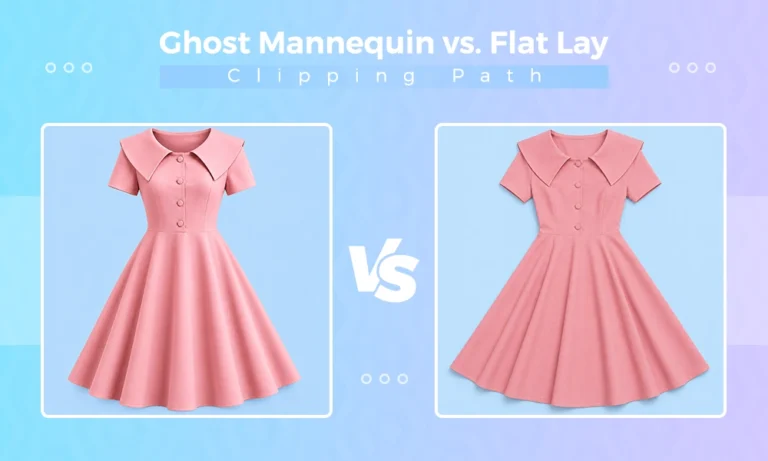
When it comes to taking pictures of products (for example, clothes), photo editing makes a big difference in how professional and attractive the resulting images will appear. Ghost mannequins and flat lay images are two popular choices for product photography, each with its own specific purpose and level of editing involved.
The way in which these images are created and edited is influenced by how the clipping path is used to separate the item from the background, as well as to add any detail and features that were lost in the original image. If you know what the differences are, then you can better select between the two types of images, time, cost, and quality when creating product imagery.
Ghost Mannequin Photography and Its Editing Complexity
Fashion eCommerce stores also utilize ghost mannequin photography because it allows a garment to have a realistic, 3D appearance without showing the mannequin in the photo. However, achieving this professional look requires a considerable amount of advanced editing to remove everything from the image that isn’t a part of the garment.
Ghost mannequin photo editing is more complicated than simple cutouts because it has multiple steps:
- Remove the mannequin from the image
- Merge the inner garment and outer garment together
- Align the layers correctly to create an authentic 3D shape
- Retouch for wrinkles, shadows, and inconsistencies
The editing process for this type of photo requires advanced clipping path techniques. Editors are often required to create multiple paths during the editing process based on the different areas of the garment (i.e., collar, sleeves, inner lining).
The complexity of ghost mannequin editing is defined by the following characteristics:
- The clothing overlaps will cause editors to have to be precise and accurate in creating their cutout or “clipping path.”
- Some of the inner portions of the garment, such as necks/backs of shirts, have to be extracted from different images.
- The editing process requires a high level of accuracy in order for it to appear realistic.
Due to the above-mentioned characteristics, ghost mannequin editing requires many hours of work and skilled professionals who understand garment photography and advanced Photoshop techniques.
Also Read: Ghost Mannequin Photography Guide
Flat Lay Photography and Basic Clipping Path Needs
Flat lay photography is also much easier to edit. The flat lay style of taking pictures consists of placing an article of clothing or a product on a flat surface and shooting from above to provide a clean, minimal, aesthetically pleasing image.
The basic requirements for editing flat lay photos are pretty simple. The following three elements are required when editing flat lays:
- Removing the background from the image
- Creating a basic clipping path for the object
- If necessary, fixing minor imperfections in the clothing, such as wrinkles or bad lighting
Because flat lays are all flat, there is less overlap, and none of the objects have internal parts that need reconstructing.
It’s easier because
- In most cases, only a single-layer clipping path will be needed
- There is no need to combine several photos into one for a flat lay
- It’s much easier to define the edges of flat lay objects
Flat lay photos are great for brands that need some quick and inexpensive visuals to promote their product with some, but not too much, editing. While there still has to be accuracy, there is much less complexity to flat lay photography versus ghost mannequin photography.
Key Differences in Clipping Path Complexity Between Ghost Mannequin and Flat Lay
The two styles can be compared with regard to the complexity of their clipping path.
- Clipping Path Quantity: It generally requires multiple clipping paths to make transparent the various parts of the ghost mannequin, whereas the flat lay will usually only require one continuous path.
- Clipping Path Layers and Composition: The ghost mannequin will typically require multiple images with layers to create the effect of a disappearing mannequin, whereas the flat lay will usually only require one image.
- Precision: For a realistic 3D look, the ghost mannequin has an extremely high precision requirement; whereas the flat lay can have a lower degree of precision and still be a clean cutout.
- Time and Effort: Creating the ghost mannequin images is a very time intensive and laborious job; whereas creating flat lay images is usually faster and easier.
- Skill Level: For creating ghost mannequin images, more advanced skills are required; whereas less advanced skills will suffice to make flat lay images.
In summary, images created using the ghost mannequin method require much more complex clipping path workflows than images created using the flat lay method.
When to Use Complex Clipping Paths in Apparel Photography
Selecting whether to do a ghost mannequin or flat lay will largely depend on your goals, your budget, and your overall brand image.
The Ghost Mannequin Will Work Best When:
- You want to show garments in a realistic way from all angles.
- You are an eCommerce store focused on professional fashion products.
- You will be selling garments where the fit and structure of the garments is very important.
- You are willing to spend extra money on high-quality image editing.
The Flat Lay Will Work Best When:
- You need to create images quickly and at a low cost.
- You will be using images primarily for social media purposes or in catalogs.
- You prefer to have a minimal, aesthetically pleasing display of a product.
- How the garment is constructed will have little or no bearing on your decision to buy it.
Examples of When to Use Complex Clipping Paths:
- High fashion photography.
- Garments like jackets or suits with many layers.
- Products with extremely intricate details (laces, folds, inner linings).
Examples of When to Use Simple Clipping Paths:
- T-shirts, simple clothing, and accessories.
- Lifestyle/Instagram images.
- Uploading large quantities of product images in tight timeframes.
Once you have identified these specific instances, this will help you understand when to invest time in more complex clipping paths and/or when to simply use the fastest solution possible.
Also Read: Marketplace Image Standards for Amazon, Shopify, Walmart & Etsy
Conclusion
Ghost mannequin photography requires a lot more complex post-processing than flat lay photography when you look at the complexity of the clipping path. You have to remove the mannequin and construct hidden parts to make it look like a realistic 3D image, which is a detailed and labour-intensive process.
Flat lay is quick, easy, and has minimal editing requirements. Your choice should ultimately depend on what you are trying to achieve with your business. If you want to give a realistic and high-end presentation, a ghost mannequin is worth the effort.
Unsure which editing style fits your budget? Whether you need high-volume flat lay cutouts or complex ghost mannequin compositing for a luxury catalog, Visuals Clipping has the scale to handle it.
Frequently Asked Questions (FAQs)
Q1: Does ghost mannequin require more editing than flat lay photo shoots?
Ans: Yes, ghost mannequin requires much more editing than flat lay photo shoots because of the added layers, complex clipping paths, and multi-layer reconstruction of the images.
Q2: Do flat lay photo shoots always use a clipping path?
Ans: No, not always, although clipping paths tend to be used frequently for removing backgrounds and showcasing the product.
Q3. Why is ghost mannequin so popular?
Ans: Ghost mannequin provides a realistic-looking 3D image to help customers visualize how the item will fit and appear once they receive it (not including background items).
Q4. Is ghost mannequin editing too challenging for beginners?
Ans: Yes, ghost mannequin editing typically requires average to advanced Photoshop skills and experience, thus, most beginners struggle with completing ghost mannequin edits on their own.
Q5. Is flat lay photography considered less professional than ghost mannequin?
Ans: It depends on your target market. Because flat lay has more minimalistic-type styles and images, flat lay may be more appealing to consumers.
Q6. Is it cheaper to edit flat lay photos in bulk than to edit ghost mannequin photos?
Ans: Yes, flat lay editing is less expensive and may take less time to produce; therefore, flat lay items are typically less expensive to purchase than ghost mannequin items.