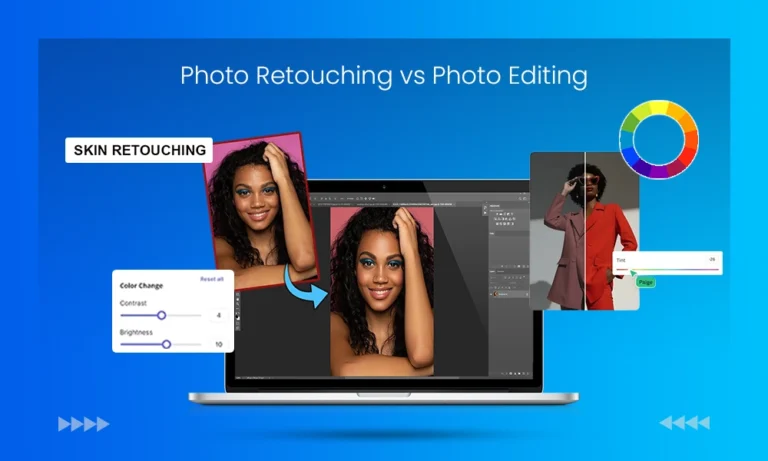
Photos can be altered to create higher-quality versions than what came out from the camera with the use of editing software. Businesses rely on photo editing as well as photo retouching to create images that appear professional and to attract customers.
When a business, photographer, or marketer understands how to differentiate between these two types of image alteration, they will know when to choose one method over the other.
By having an understanding of both photo editing and photo retouching, businesses will have an advantage in choosing the best way to produce their final visual product based on the target audience they wish to attract.
Whether the goal is to produce an image for use in e-commerce or to produce an advertisement, being aware of the differences between photo editing and photo retouching will save time and money when choosing a service to meet your needs.
Introduction: What Is Photo Editing vs Photo Retouching?
Photo Editing: Refers to making broad-based improvements to photographs to enhance an image’s overall look and feel. Photo editing typically involves making improvements in relation to technical parameters associated with images including lighting, colour balance and composition.
In addition to other enhancements that enhance a photograph’s visual impact and enhance its impact across other areas (such as social media) where it may be viewed and used.
Photo Retouching: Photo retouching involves refining the details of photographs for improved image quality or to remove unwanted objects from the photograph.
As such, photo retouching may include the removal of imperfections in the photograph, creating detailed image enhancements, and is intended to provide an image with a polished look, yet still appear natural.
Generally, the general timeline for performing photo editing and photo retouch is as follows:
- Photo Editing
- Photo retouch when more precision is required
Overview of Photo Editing: Broad Image Enhancements
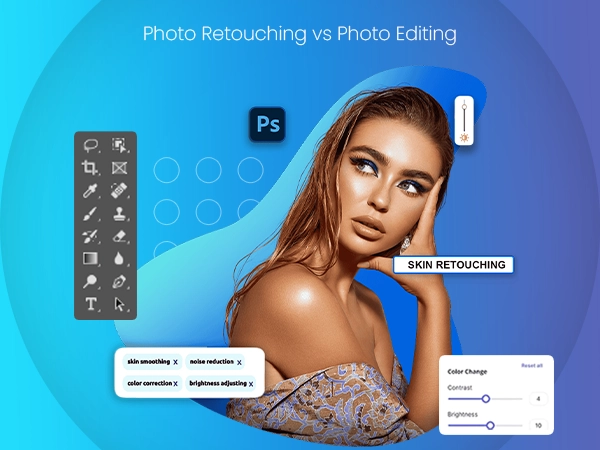
Photo Editing is the process of applying changes to an entire photograph or image file. Most commonly used in the production of images for digital/social media and marketing, eCommerce stores
Photo Edit Characteristics:
1) Changes the brightness/contrast/exposure of the full-size image.
2) Fix the white balance & Color Tones.
3) Crops/Resizes for different website placements.
4) Maintains Consistency across multiple Photos.
Examples of Industries Using Photo Editing Services:
1) eCommerce
2) Real Estate Listings
3) Events/Lifestyle Photography
4) Website/Social Media Content
5) Since many photo editing processes are able to be automated or performed in Batch Process
Photo Editing is the most efficient way to process a large volume of photographic images.
Understanding Photo Retouching: Fine-Tuning Image Details
Photo retouching is more specialized than basic photo edits; the focal point is on the imperfection of the image and how to correct that while preserving some of the characteristics of the original image with the aid of skilled experts and advanced technologies.
When it comes to photo retouching; in addition to normal photo edits you may do the following:
- Smooth skin and remove blemishes
- Reduce wrinkles and scars without losing the texture of the skin or other surfaces
- Remove distracting elements and objects
- Induce the appearance of fine detail on products or the smaller areas of an image.
Photo retouching is typically associated with:
- Photography related to fashion and beauty
- Advertising, sales and promotional material
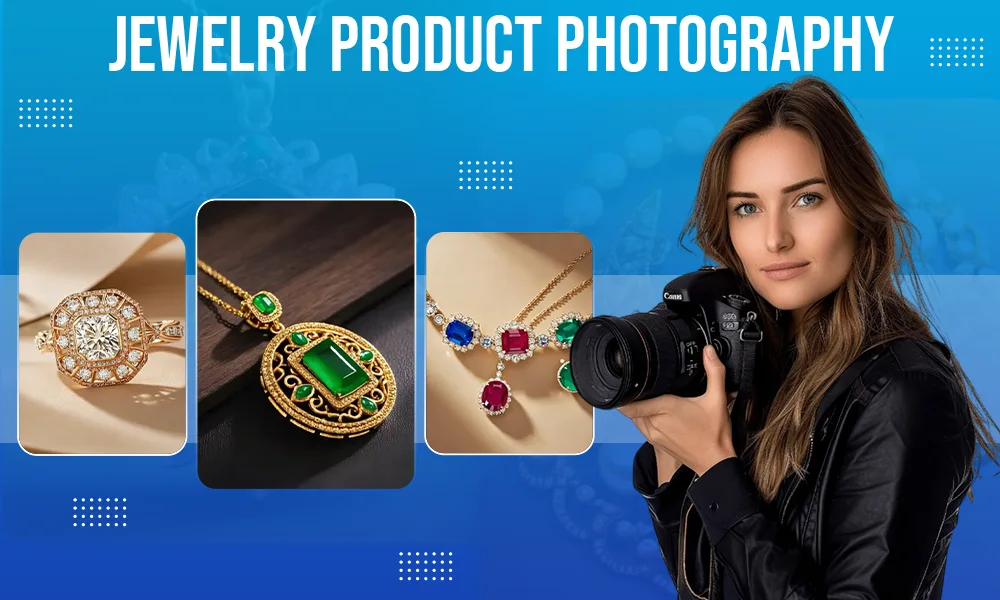
- High quality images of products
- Professional portrait photography
Unlike the type of photo editing you typically perform, most of the time retouching is done by a human and is very customized for the individual image, which makes this process much more time consuming to produce, but produces a significantly higher quality image.
Key Differences Between Photo Editing and Photo Retouching
Here are the key differences between Photo Editing and Photo Retouching
| Aspect | Photo Editing | Photo Retouching |
| Definition | Improves the overall look of an image using global adjustments. | Enhances specific areas of an image by refining fine details and imperfections. |
| Primary Goal | To make images clean, balanced, and visually consistent. | To achieve a flawless, polished, and high-end appearance. |
| Scope of Work | Applies changes uniformly across the entire image. | Targets selected areas for detailed corrections. |
| Level of Detail | Basic to moderate enhancements. | Advanced, precise, and detail-oriented refinements. |
| Common Techniques | Color correction, exposure adjustment, cropping, resizing. | Skin smoothing, blemish removal, object removal, texture enhancement. |
| Workflow Stage | Usually the first step after image capture. | Performed after photo editing for refinement. |
| Time Required | Faster and suitable for bulk image processing. | Time-intensive due to manual and image-specific work. |
| Skill Level | Basic to intermediate editing skills required. | Advanced professional retouching expertise required. |
| Automation | Can be automated or batch-processed. | Mostly manual and cannot be fully automated. |
| Effect on Image | Enhances overall quality without altering core details. | Improves details while maintaining natural realism. |
| Risk Factor | Over-editing may affect color accuracy. | Over-retouching may result in an artificial look. |
| Cost | More affordable and scalable for large volumes. | Higher cost due to expertise and time involved. |
| Best Used For | E-commerce, real estate, events, and catalog images. | Fashion, beauty, advertising, and premium visuals. |
| Consistency | Ensures uniform appearance across multiple images. | Customized per image for perfection. |
| Business Impact | Makes images market-ready and professional. | Adds premium value and enhances brand perception. |
When to Use Photo Editing vs Photo Retouching
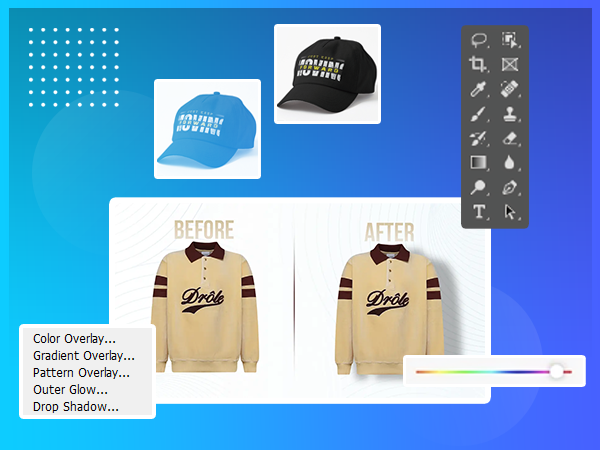
The decision to edit or retouch a photograph depends on your objectives, budget, and how your images will be used.
Photo editing is best used when:
- You are looking to edit multiple images at one time,
- It is more important for your images to be consistently edited and processed quickly,
- You are going to use the images for an online store or catalogue.
Photo retouching is best used when:
- Your images will be used in branding and advertisement,
- Fine Detail is essential,
- You want high-quality polished pictures.
Many times, combining photo editing and photo retouching will give businesses the most effective outcomes.
Professional Photo Editing and Retouching Services at VisualsClipping
Visuals Clipping is your source for Professional Photo Editing & Advanced Photo Retouching Services for Business Needs. VisualsClipping has a team of experts that makes sure that every image they edit meets the high-quality visual standards for natural realism and brand consistency.
Reasons to Work With Us:
- Professional Editors With Many Years of Experience in The Industry
- Flexible Options to Meet Bulk, Large, Or High-End Projects
- Rapid Turnaround Times Without Sacrificing Quality
- Customizable Editing and Retouching Services
Whether you want clean, consistent photos or high-end retail style edited & retouched visuals, Visuals Clipping will help you improve your visual content and stand out from the competition!
FAQs
Is photo editing or photo retouching better for my eCommerce store?
Ans: For standard product listings, photo editing is usually the best choice. It ensures your images have consistent lighting, accurate colors, and the correct dimensions for your website. However, if you are selling high-end items like jewelry or luxury watches, photo retouching is recommended to remove micro-scratches and highlight fine details that make the product look premium.
Q2. Can I automate the photo retouching process?
Ans:Unlike photo editing, which can be done in batches (like applying the same color filter to 100 photos), photo retouching is a manual, specialized process. It requires a skilled professional to look at each individual image to smooth textures or remove specific distractions. Because it is highly customized, it cannot be fully automated without losing quality.
Q3. Does photo retouching make images look fake?
Ans: When done professionally, no. The goal of high-quality retouching is to provide a “polished yet natural” look. Over-retouching can lead to a “plastic” appearance, but our experts at Visuals Clipping focus on preserving natural textures while only removing unwanted imperfections.
Q4. Why is photo retouching more expensive than editing?
Ans:Retouching is a more time-intensive service that requires advanced technical skills. While an editor can process dozens of photos an hour using global adjustments, a retoucher might spend an hour or more on a single image to ensure every pixel is perfect. You are paying for the precision, expertise, and manual labor involved in creating a high-end visual.