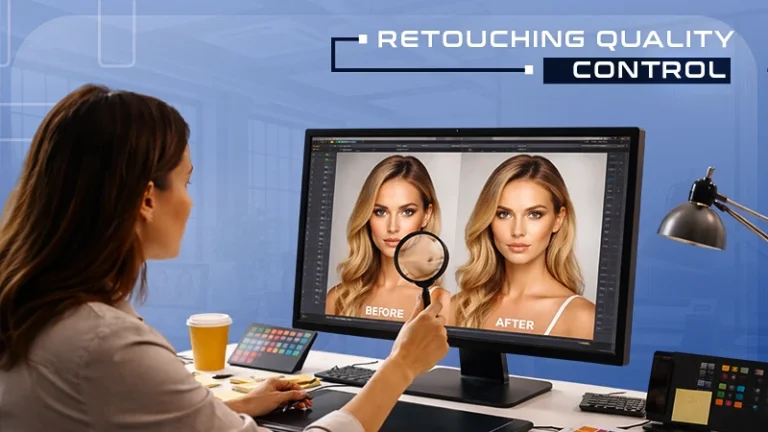
When a company lets a graphic designer edit 500 images on their behalf, one might think that these edited images would all match perfectly. Unfortunately, due to the overwhelming majority of graphic designers working from home, the edited images may have many similar yet different features.
Minor differences in colors, missing dirt particles, or messy clipping paths that were left over from an earlier designer’s work will exist among the various designs submitted by graphic designers who have never been employed in a studio environment.
At Visuals Clipping, we know that talent alone doesn’t scale, processes do. This guide examines the process of ensuring the quality of photo retouching through a 5-stage Quality Control (QC) workflow for all photographs submitted to a top-quality photo editing and retouching company.
The QC Problem No One Talks About
Variation in editing due to the volume is sometimes due to how many retouchers are working on-shift at any given time. Minor differences between retouchers’ styles can lead to inconsistencies in their work quality.
If there is not a successfully structured photo retouching company’s quality assurance process within its workflow; quality turns into something subjective, and who prefers what becomes subjective. If you multiply that by hundreds of images, it becomes further removed from being “like” each other.
Implementing an effective professional photo editing company’s QC will reduce subjective guesswork by implementing systems, establishing clear guidelines, identifying checkpoints to be used as points of control, and holding individuals accountable for all aspects of the process related to their respective role.
What Poor QC Actually Costs a Business?
Inadequate Quality Control after the production phase affects more than just the final product’s appearance; it directly affects the company’s bottom line and consumer confidence in their products.
Reasons include:
- The number of product listings rejected for non-compliant backgrounds
- The amount of returned goods due to the misrepresentation of color on product images
- The lack of credibility customers have in a company because of differing product catalogs
- Time spent reviewing or rejecting poorly produced images
- The hidden costs associated with re-editing, re-listing, and lost sales from downtime
To sum up, poor quality control (QC) has a significant financial and operational impact.
Stage 1: Client Brief Review
To successfully maintain a photo editing quality control process, starting with clarity is essential. Project managers study the client’s brief to confirm that it is both actionable and complete. This reduces ambiguity, which can lead to inconsistent retouching results.
Key checkpoints in this process include:
- Color expectations (enhanced vs actual)
- Reference images and guidelines
- Missing or unclear instructions
- Normalizing criteria into a standard format
Experienced retouching teams do not only follow briefs; they will also make necessary refinements. Closing any gaps sooner rather than later allows for fewer costs associated with retrospective changes.
Also Read- How to Start with Visuals Clipping
Stage 2: Retoucher Assignment and Skill Matching
Different types of images utilize varying amounts of skill for their editing. A successful image editing business with an established quality assurance process employs an effective means of task allocation.
Assignment of images is based on specialization:
Jewelry images require significant attention to precision and managing reflections;
Fashion/smooth skin images typically require retouching that appears completely natural and manages the overall texture of the skin; and product images require color matching and maintaining a clean edge.
Why assigning images according to specialization is important:
- Consistency of output from specialized editors
- Fewer corrections required in later stages
- Faster turnaround times without jeopardizing quality
Many of the best image editing companies also have established internal rating systems, guaranteeing that only high-performing editors will be given responsibility for important projects.
Stage 3: In-Progress Quality Spot Checks
Checking quality at the last minute is a bad idea. That’s why quality control during post-production has in-progress checks. Supervisors will check work while it is being edited to find problems as quickly as possible.
A few common signs of trouble are:
- Color differences from the reference
- Over-retouching or the texture looks very unnatural
- Shadows and highlights are inconsistent
- Poor masking and/or edge refinement
When problems occur, the retoucher gets immediate, structured feedback. This provides a rapid feedback loop between QA and the retoucher and eliminates repeating issues between the same batch of content. This step is very important for keeping things consistent on a massive scale.
Stage 4: Final QA Review Before Delivery
Prior to an image being delivered to a client, they undergo a rigorous final review process, which is integral to any professional image editing quality control (QC) workflow. This phase emphasizes quality and precision with very few exceptions.
What QA Teams Look for:
- Edges & Masking: Cut lines should be clean with no halos and appear natural in the surrounding area.
- Color Accuracy: Image colors should match reference images as well as brand color standards.
- Dust & Imperfections: Each image should not have any missing areas or artifacts.
- Consistency: The entire batch should have the same appearance.
Every image is evaluated pixel by pixel as needed; the objective is to provide no surprises to the client. This is where a reputable photo editing & retouching service stands apart from the others, they identify defects that others have missed.
Also Read- Top Photography Trends for 2026
Stage 5: Client Review and Revision Loop
Feedback will always be part of the experience, even with good Quality Control (QC). It’s about how efficiently feedback is managed.
A structured revision process offers:
- Fast revisions of requested changes
- No loss of quality in the revised product
- Clear communication of changes or revisions
Professional teams monitor feedback trends and adapt them into future work processes. Over time, this will reduce revision cycles and have a positive impact on meeting client expectations. As part of the quality assurance cycle, this continuous improvement process is critical for photo editing businesses to consistently deliver quality photos.
Technology That Supports QC
The key to an effective post-production quality assurance system is having the correct technology.
Essential Systems/Tools:
- Calibrated Monitors: Provide color accuracy between different devices.
- Project Management Tools: Help teams track progress, assignments, and deadlines.
- Version Control Systems: To maintain consistency and prevent errors in files.
Technology supports the way we think, as well as being used by us to support/scalable accuracy without any loss of detailed information.
How Clients Can Help Achieve Better Editing Results
The quality control process is everyone’s responsibility. Clients give editors precise input and editors generate precise output.
Client’s Best Practices:
- Provide clear references and visual examples of the expectations for color, tone, and finish
- Provide consolidated feedback, as opposed to giving separate revision comments
- Build trusting, long-term relationships with your editor to ensure consistency in the final image
When the client and the editor are aligned, the speed, ease, and reliability of the quality control process for photo retouching will be improved.
Conclusion: Quality Is a Process, Not a Promise
Talent is not the sole source of consistent outcomes in photo editing since a structured, dependable process is typically required. Creating a defined quality control process for photo retouching will guarantee that every image is of the same high quality, irrespective of volume.
The processes involved in getting a photo from intake to delivery help to remove mistakes and maintain brand consistency. Would you like to experience precision editing for yourself? Request a free sample edit today to see how a professional quality control (QC) process can help you achieve your editing goals.
Frequently Asked Questions
How do you ensure color consistency across a batch of 500+ images?
At the start we set a “master look”. Our lead editor finalizes a few reference images and all other images are edited and QA to those reference images to ensure everything is the same. This will make your complete batch look the same on all platforms.
Does AI handle the quality control, or is it done by human editors?
AI assists in simple work, and the ultimate quality is always checked by human specialists. They pick up details such as edges, shadows, and general visual sense that AI is not able to pick up. This human element will ensure that the results are in line with your brand aesthetics.
What happens if I find an error in my delivered files?
No problem. Just request a revision, and we’ll fix it within 4 hours, completely free, until it matches your expectations. Your satisfaction is always our top priority.
Can I provide my own brand style guide for your QC team to follow?
Yes, and it’s encouraged. You can give us references, colors and guidelines and we will adhere to them closely in the editing and QC process. This assists us to provide results that match with your brand.
Does a 5-stage QC process delay the delivery time of my images?
Not at all. QC is incorporated into our work process, and we inspect things during editing. That is the way we ensure that delivery is fast even when dealing with a huge order. Speed and accuracy are not compromised.