Product photography could be a great practice for marketing students and for design students, a very useful exercise to learn textures, surfaces, shadows, etc.
If you’re thinking of going into a profession in product photography, you will need a strong portfolio. This does not need expensive equipment to start,
Read this blog to learn more about the details of product photography
Product Pictures Make You Think From the Customer’s Perspective
When making a product picture, you don’t just focus on making it good to the eye. What a person seeing a product picture wants to see is its shape, size, color, texture, usage method, and any other parts of the product in question. This means that there should be a reason behind any visual part of the picture.
For marketing majors, this will be helpful as it will change their way of making advertising pictures or pages. Not just asking, “Does it look nice?”, you will start to ask, “What does the customer need to see?”
When a Big Final Project Takes Over Your Creative Time
Design and marketing students have many projects happening at once, and a large final paper can take the hours you planned to spend taking photos, testing layouts, or making a portfolio. That can be annoying when practical work is the part that helps you grow a real creative skill.
If academic writing starts taking over the week, using EssayPro as a capstone project writing service can provide support with a big written task while you keep more time for your own classes, photography practice, and design work.
With the workload under better control, you can spend more time shooting, editing, and testing ideas that may become good portfolio pieces.
Understanding Lighting Is Far Simpler Than Ever Before
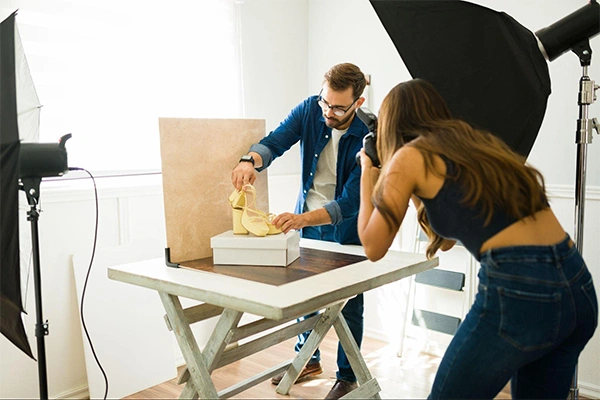
One can learn about lighting from a design manual, but in product photography, you have to immediately see how a change produces different results. Place a bottle close to the window and take an image. Then place the bottle far away, add white paper as a reflector, or change the direction of the light source to get a new effect.
Such hands-on experience will allow you to see the concept of shadow, highlight, shape, and texture. It will help you realize why some products are more difficult to photograph than others because items such as glass, metal, fabric, or food have a different reaction to light.
Compositions Are No Longer Abstract Principles of Design
Design courses often cover the basics of balance, space, contrast, and visual. Product photography offers an easy exercise to practice all of them. You control the position of the thing, the amount of space around it, and the use of props. And you realize that adding more objects does not really make the picture better.
According to the guidelines on product photography by Adobe, you should first use soft and uniform lighting and keep it simple in the composition to highlight the product. Also, you should know the importance of having many angles and making consistency within the series of pictures. These guidelines are useful for students as they relate theoretical ideas to practical commercial examples.
A Single Item Will Teach You Multiple Kinds of Photography
To practice, you don’t have to buy ten things. You will only need to use one single thing and take many kinds of shots. The water bottle, shoe, notebook, candle, or packaging of your favorite meal will be ok for you to try with. The idea is to find out how the same object looks if its reason changes.
Try taking:
- one clean shot in a plain background
- one close-up shot that shows textures or details
- one lifestyle shot of the product in use
- one shot for social media
- one wide shot with enough space for the text of an advertisement
Every shot will solve a different design problem. While the first shot may be great for your online shop, the second one can turn out perfect for social media. The wide shot teaches you to have some space for text. This is where photography turns into a part of marketing.
Product Photography Will Help You See How Brands Develop a Visual Style
Sometimes, brands do not pick any photos randomly. The pictures have common things such as the same lighting, color tones, background, angle, editing style, etc. Such a visual language makes it easy to find the brand without seeing its logo. Studying product photography will help you to make your own visual style.
Pick any imaginary brand and set up three rules. Maybe you will pick warm lighting, a light background, and close shots. Take pictures of a few products using these rules consistently.
Practice Doesn’t Have To Cost a Fortune
You don’t need to have pricey tools to start. Using the camera in your smartphone lets you learn about framing, lighting, backgrounds, and basic editing skills. You can use a white card for a reflector, and paper or cloth as backgrounds. With a bright window and a chair, you will find yourself in a small photography studio.
It is very helpful with your student budget already small. You may have seen ads advising that you should invest in new software, lenses, lights, and other tools right away, but creative practice does not have to start with a tool list. Begin where you are, buy a capstone project to free your time, and then get only the tools that solve specific issues.
You Learn Skills That Connect Across Several Jobs
Product photography is good because the skill does not stay in only one career. A designer may need it when making a website. A marketer may need it for a campaign. A small business owner may need it because having a photographer for every social post is not possible.
| Skill You Practice | Where It Can Help |
| Lighting | Photography, video, social content |
| Composition | Graphic design, ads, websites |
| Editing | E-commerce, content creation |
| Brand consistency | Marketing and art direction |
| Visual storytelling | Campaigns and social media |
| File preparation | Websites and online stores |
| Customer thinking | E-commerce and advertising |
This mix can make the skill very useful for students who are not sure which creative role they want yet. You are learning photography, but you are also learning about design systems and marketing goals. One little shoot can do many parts of a real campaign. That makes practice time much more useful.
It Could Grow to Be a Larger Student Project
Once you know the basics of taking photos, this way can be used for another, bigger marketing project. You might want to make a small brand of your own, take photos of it, have packaging, social media content, and an online store. And then, you are doing much more than just practicing photography – you are making an entire visual campaign!
Such a project could also be good for your capstone project, as it will mix many different skills revolving around one common topic. You will be able to use your research, design skills, your knowledge of photography and editing techniques, as well as marketing. Your final project will seem much better than a bunch of different tasks.
A Camera Can Teach More Than Photography
Start small and photograph something you already have. Make a clean store image, a lifestyle version, and one photo made for an ad. Compare them and ask what changed and why. A simple afternoon of practice can teach you a lot about design, marketing, and the way images sell ideas.
Frequently Asked Questions
Q1. How do you get into product photography?
Ans: You need a portfolio(opens in a new tab) to showcase product photographs to potential clients. Get some products and take different shots. You can even use products you have lying around the house. Many new product photographers start freelance gigs with minimal compensation to build their product photography portfolios.
Q2. How to get product photography clients?
Ans: Word of mouth is the main source of how product photographers get new clients, followed by portfolio websites (like Zenfolio) and social media (Instagram). You can also try other methods to find new clients via Facebook, Google search, agencies, LinkedIn, or other social media sites with an emphasis on images.
Q3. How do I sell my product photos?
Ans: You can sell your product photos by creating courses and workshops, selling prints online, and selling digital downloads. You can also sell your product photos by making in-person sales or self-publishing photo books. Most product photographers sell their photos by doing photoshoots for their clients, while others focus on stock photography.