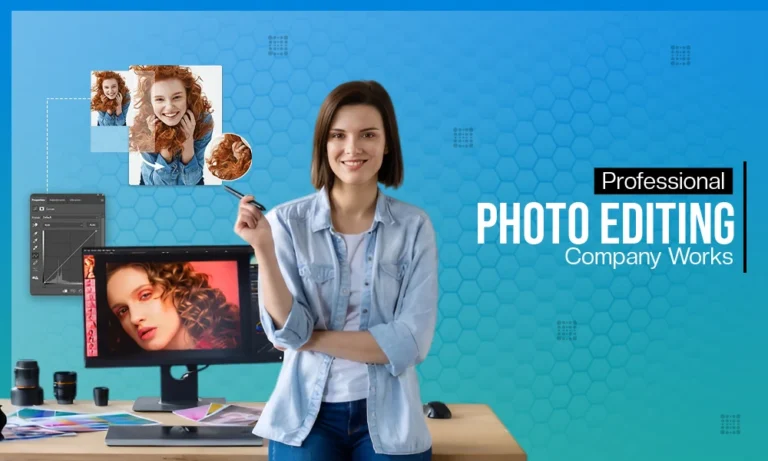
When you are in the process of outsourcing photo editing, typically, you will have no idea what goes on in between uploading your images and getting finished files back. When editing your photo, who did the editing? What tools did they use? How did they guarantee the quality of the final product?
This can be difficult to do since companies are sending hundreds of product photos, and photographers who outsource galleries of their work require trust when they send their work to other companies.
This guide provides an overview of professional photo editing workflows so that you can see, in detail, how the photo retouching company processes images from initial receipt to final delivery.
Who Is Actually Editing Your Images?
A professional editing process entails much more than having an “editor.” It involves assembling a team of experts to work together and provide a framework for the success of the project, where each team member has a specific function and is responsible for producing images that are accurate, fast, and consistent.
Project Coordinators: the First Point of Contact
The project coordinator is the first point of contact for the entire project from the time an order is placed until it is completed.
Some of the responsibilities of the project coordinator include:
- Reviewing and accepting/denying orders.
- Reviewing and accepting or denying client instructions (the “brief”).
- Creating/retrieving style guides.
- Assigning work to the appropriate group.
During the project coordinator’s intake process, they will validate the following:
- High quality and resolution of files.
- Well-defined instructions.
- Reference images.
- Turnaround expectations.
By ensuring that everything is set up properly when the actual editing begins, the project coordinator can avoid costly errors or revisions to the project.
Specialist Editors by Service Type
Expertise, not availability, is a determining factor for companies in providing their services professionally.
- Clip Path Specialist: Uses the pen tool in 100-200% zoom while being very precise when creating sharp edges.
- Retoucher: Specializes in editing portraits, products, jewelry, and fashion.
- Real Estate Editor: Works with HDR blending, perspective correction, and balancing light.
- Colour Grader: Works with calibrated monitors to ensure batch consistency.
- Senior Editor: Handles more complex tasks, such as masking hair, detailing the jewelry, and creating composites.
The efficiency of these companies is also due to the way that they operate through specialization.
QC Editors: the Independent Review Layer
The quality control team is entirely independent from the editing department.
- They do not audit their own edits
- They adhere to precise checklists for evaluation
- They inspect the edges, accuracy of colours, and consistency.
The quality control team acts as the last human review before the work is shipped/delivered to the client.
Account Management for Returning Clients
Coordinators are assigned to clients who return again and again.
- Consistent style across all orders
- Reduced frequency of repeating same instruction numerous times
- Long-term efficiency of workflow
Continuity is important for brands who use photo retouching services by outsourcing them; this also applies when they’re scaling up volume.
The Tools and Environment Behind Professional Photo Editing
The performance of your equipment, as well as the environment in which you work, affect the quality of the outcomes you produce more than the level of your own expertise.
Hardware That Affects Output Quality
Monitors that are calibrated allow you to accurately represent colour (according to sRGB/ADOBE RGB colour standards). Graphic tablets allow you to manipulate a masking or clipping path accurately. High-RAM workstations allow you to work efficiently with large RAW files and/or high-layer edits.
The output produced by uncalibrated or underpowered systems will be inconsistent; therefore, if you plan to outsource your production to someone else, you must carefully consider this risk factor.
Software Stack
The following is a summary of each tool’s primary role in professional photo-editing:
- Photoshop: Core image editing, retouching, masking & compositing;
- Lightroom: Batch image editing & color correction;
- Capture One: Used mainly for high fashion & upscale photography workflows;
- Bridge: Organizing files & pre-processing images.
These are not interchangeable tools, but rather are designed to work with each other to provide a methodical and efficient workflow.
What Happens to Your Images From Upload to Delivery
Trust is built when there is an understanding of how a photo retouching company’s workflow works in full detail. The following steps will outline how exactly a photo retouching company’s process operates.
Stage 1: File Receipt and Brief Review (0–15 Minutes)
Files come in through upload systems such as Dropbox or Google Drive and Emails.
- All briefs will be reviewed by the editor and checked to see if there are any missing pieces of information.
- If necessary, the editor will create or retrieve a style guide.
The process of editing will never start if the minimum amount of information is not provided to the editor.
Stage 2: Complexity Assessment and Team Assignment (15–30 Minutes)
Every Image Category Will Be As Follows:
- Simple
- Medium
- Complex
- Super Complex
From This Information, You Will Have:
- Who will be the editor
- What techniques will they use
- The time it will take to process the image.
The mixed batches will be assigned to different teams. This is how companies can offer fast turnaround, even for huge orders.
Stage 3: Editing (Varies by Complexity)
Editors work off style guides that are documented, not based on what they assume.
Typical Workflows Include:
- Product on a White Background: Removal of Cutouts, creation of shadows, Ensuring Color Accuracy
- Fashion Retouching: Refining Skin Yet Retaining Texture
- Real Estate HDR: Blending Exposure and Correcting Perspective
Before Submitting Work to the Customer, Each Editor Will Review Their Work.
Stage 4: QC Review (1–3 Hours)
QC operates as a separate layer from the other 3 layers; there should be a pixel by pixel examination of each image, comparative to other images in the batch, and any rejected images will have specific rejection notes.
This is the organizational and systematic review process, which creates a reliable professional photo-editing workflow.
Stage 5: Delivery Compilation and File Transfer
Prior to file delivery, the QC team will perform this checklist to ensure the following:
- The correct count of files as to what was edited
- Consistent naming of all files
- Correct format (TIF or JPG) and resolution
- Correctly nested folder structure
After assembly, files shall be delivered via secure download (also with a confirmation summary).
Also Read: How to Start with Visuals Clipping
How Turnaround Times Are Actually Achieved
Rapid delivery isn’t just rushing; it requires good design in the process. By working in multiple time zones, we can begin processing submissions quickly. While one area of the world sleeps, other teams will be working on editing.
This is how we can get large batches of 500 images delivered on time.
- Distributed among multiple editors
- Simultaneously processed
- Reviewed for quality concurrently
This method of workflow enables large batches to be delivered within short timeframes.
When Rush Delivery Is Triggered
For urgent requirements:
- Orders bypass the standard queue
- Dedicated editors are assigned immediately
- QC is prioritized simultaneously
Express options (3-hour or 12-hour) are available without compromising quality.
What Happens to Your Files After Delivery: Data Security and Confidentiality
Companies treat every file as a sensitive asset of their business.
NDA and Confidentiality Policy
All files are handled with a strict non-disclosure agreement; no file will be used for portfolio purposes without the client’s prior consent; all metadata and file naming conventions are kept confidential.
File Retention and Deletion
File Retention and Deletion Policy – Files will be retained on a temporary basis for retention purposes; all files will automatically be deleted after they have exceeded their retention period; additional file storage can be requested by a client.
This is especially important for industries that have unreleased goods or other sensitive visual information on the files.
Conclusion
The best photo editing services will have a structured process to deliver quality retouching. They go through an initial brief review and assign an editor to the project; the editor edits the images, completes independent quality checks, and delivers the final images securely to the client. This means the final product is not based on just one person’s opinions but is dependent upon a system that produces consistent and scalable results.
If you’d like to see how a professional workflow operates with your own images, we would be glad to edit 10 images for free! You will not be required to pay to have your images edited.
FAQs
Q1. How do photo editing companies keep their output level from batch to batch the same?
Ans: Companies offering photo editing services have a structured workflow, style guide, and independent QC team to guarantee consistencies in output.
Q2. Is it safe to outsource your photo editing project?
Ans: Yes, provided the photo editing company you choose to work with adheres to the following security measures – an NDA policy, secure file handling procedures, and an established file retention policy in place.
Q3. How long will it take for my photo editing to be completed?
Ans: Each photo editing project has a different complexity level. However, most photo editing companies provide photo editing within 12-24 hour turnaround times, using parallel workflow processes.
Q4. What image types can you outsource?
Ans: You can outsource product photos, fashion shots, real estate shots, jewelry, and more.
Q5. Why is there a fast turnaround time on large batches?
Ans: Because each editor assigned to your order processes the photos in parallel, which means that processing occurs at the same time as opposed to sequentially.